Wednesday, June 5, 2013

More on Flooding

Use this link to go and see a fascinating view of the city of Passau, Germany before and after the flood.
http://www.spiegel.de/panorama/foto-vergleich-zur-flut-passau-vor-und-waehrend-des-hochwassers-a-903482.html

Slide the line back and forth to see the difference.

Tuesday, June 4, 2013

German town sees worst flooding in 500 years

Large areas of central Europe are experiencing their worst flooding in decades after heavy rainfall last week pushed rivers beyond their banks.

Southeastern Germany and southwestern Czech Republic and Austria have been hardest hit.  We are up on the Main river (Frankfurt am Main) at about the NW corner of the box with 'Passau" in it on this map.
The Main River has sloshed out of it's banks, but only up onto the park and sidewalks lining the river.  The city itself is up about 12 feet higher.  Boat traffic has been stopped as they cannot get under the bridges.


16th C homes: worst flooding since they were built!

Definite problems for farmers later this summer.

At least 12 people have died across Germany, Austria, and the Czech Republic, and thousands were forced to evacuate their inundated homes.
Red Cross rescuing people in Passau, Germany


Hope they have some food storage.

The Autobahn: cars are NOT speeding there today.  'Ausfahrt' means 'Exit.' 
This is Passau normally, so you can see why it flooded.  The Dom (cathedral) is the home to the 
largest church organ in the world, with 17774 pipes and 233 registers, is high enough that it did not flood - yet. 
Passau: confluence of the Danube, Ilz and Inn Rivers
You can see where the river bank is by where the cruise ships are anchored.

In Passau, Germany – along the confluence of the Danube and Inn rivers – floodwaters rose to their highest levels in over 500 years. The city declared a state of emergency after swollen rivers cut off outside road access. Hundreds of soldiers from the German army are being sent to flooded areas in southeastern Germany to provide disaster relief.


In the Czech Republic, the country is on high alert for its most severe flooding since at least 2002. Authorities closed the iconic Charles Bridge in Prague, where the Vltava River is flowing at 10 times its normal volume through the Czech capital, writes the BBC.

The Bells, our Humanitarian couple in the Czech Republic, are helping the stakes there coordinate the clean up efforts.  The Church has purchased shovels, bags, boots and other clean-up tools.  You may soon be seeing yellow 'Helping Hands' vests in photos from Prague.

This statue was almost completely covered before the waters quit rising.


I guess if your truck gets stuck in the flood, you might as well just go with the flow.  These swings - big disks of trampoline fabric - are in a lot of Frankfurt's parks: entire families can get on at the same time.


Rainfall amounts
Germany’s national weather service reports that southern and eastern Germany experienced near uninterrupted rainfall since Thursday of last week.
The village of Aschau, Bavaria recorded an impressive 405.1 mm of rainfall (15.9 inches) in just four days, of which 6.71” fell in 24 hours. Several new precipitation records were set, including:
§  A monthly record of 157 mm (6.2”) in Hamburg
§  A daily rainfall maximum of 97.3 mm (3.8”) on May 26 in St. Englmar, Bavaria
§  Germany’s second wettest May since 1881
Rainfall has been equally relentless in neighboring Austria, sending torrents of runoff through Alpine streams and rivers. Salzburg, one of the rainiest cities last month, received 259 mm (10.2”) of rain, according to Austria’s meteorological service (ZAMG).

In a press release, the Austrian weather service says that May saw twice the normal monthly precipitation in most of the country’s nine provinces. Nationally, May 2013 ranked among the top 3 wettest Mays in 156 years of records (alongside 1962 and 1965).

Saturday, June 1, 2013

Missionary SERVICE?

A very interesting blog post by Greg Prince about the possible future of Mormon missionary work. 

"SEA OF CHANGE"

Four years ago the president of Wesley Theological Seminary in Washington, DC was invited to meet with the First Presidency in Salt Lake City. At the 
Aug2610-News-MotherTheresa4conclusion of his meeting he called me and said that the thing that had impressed him most about his visit was the Church’s newly announced “fourth mission”: to care for the poor and needy throughout the world, regardless of their religious affiliation. He went on to say to me that if we took that mission seriously, given the size of our missionary force, we would have a global impact.
I spoke again with this same gentleman in the aftermath of this month’s General Conference. In the opening session of the conference President Monson put numbers on the expansion of the missionary force following the lowering of the age of eligibility: 65,000 full-time missionaries currently serving, 20,000 with calls and awaiting their service, and 6,000 in the application process. The response of the Wesley president was both flattering and sobering:
The prospect of having as many as 90,000 fulltime missionaries deployed worldwide is exemplary to all other churches. The fact that this represents over a 50% increase within a few months likely presents some formidable logistical challenges, and yet I am wondering if it also opens the door to an increase in the humanitarian work of the LDS Church. Perhaps, the Holy Spirit is working to create the way for these young men and women to be engaged in public service? The possibilities for healing the sick, feeding the hungry and welcoming the alien are endless, and yet a corps of missionaries of this magnitude has the potential to make a difference worldwide.
Perhaps the possibility of this opportunity has been percolating through the minds of the Brethren as they have contemplated the effects of lowering the age of missionary eligibility. Indeed, for over a year a pilot program known as “Just Serve” has been in effect on a small scale, initially in northern California. Daytime hours are devoted entirely to humanitarian service, coordinated through the mission office; evening hours are devoted to proselytizing. Although encouraging anecdotes have emerged from this pilot program, no broad publicity has yet been given.
Might this be the time to retool the entire missionary effort? There are compelling reasons for moving away from a business-as-usual approach, not the least being the extraordinarily high attrition rate of converts (a case can be made for the percentage of attrition within the first year being in excess of 80%) and the alarming rate of inactivity among returned missionaries (numerous reports from well-informed sources regularly put the number at one-third to one-half the missionary force). The possibility of a cause-and-effect relationship between the two sets of numbers is inescapable. One can imagine how those numbers might change if missionaries spent most of their waking hours engaged in Christian, humanitarian service, truly making these “the best two years of my life”; and if converts were attracted, instead of pushed to the waters of baptism after having seen and experienced the humanitarian service of the missionaries.

Is there a sea change in the making?

Friday, May 10, 2013

Marksburg : Part 2


Since Roman times, wine has been the traditional Rhineland drink.


 Because castle water was impure, wine — less alcoholic than today's beer — was the way knights got their fluids. The pitchers on the wall were their daily allotment. The bellows were part of the barrel's filtering system. 


 Stairs lead to the... Gothic Great Hall (1435).


This hall is set up as a kitchen, with an oven designed to roast an ox whole. The arms holding the pots have notches to control the heat. To this day, when Germans want someone to hurry up, they say, "give it one tooth more."


 Medieval windows - thin sheets of translucent alabaster or animal skins – widened into the room to bring in more light : note the benches under all the windows. 


A nearby wall is peeled away to show the wattle-and-daub construction (sticks, straw, clay, mud, then plaster) of a castle's inner walls. 


Next comes the bedroom (Kremenate) of the owners. This was the only heated room in the castle: the more recent stove for heat is behind the door, covered in iron plates. 


The canopy kept in heat and kept out critters. In medieval times, it was impolite for a lady to argue with her lord in public. She would wait for him in bed to give him what Germans still call "a curtain lecture." 


The deep window seat caught maximum light for handwork and reading. Women would sit here and chat (or "spin a yarn") while working the spinning wheel.
A noble bedchamber. The castle even has a great legend. According to the story, the castle was originally known as Brauburg, and only got its current name later. The daughter of one of the Eppstein owners, Elizabeth, loved a handsome knight named Siegbert von Lahnstein, and the families approved the match. But as the wedding preparations were underway, Siegbert was summoned away to a war against Bohemia, and he was killed. Among those who came to comfort the young lady was a monk named Mark.
The following year, a man appeared, a knight named Rochus von Andechs who always wore black. He claimed to be Siegbert's cousin, and with Siegbert's inheritance he tried to claim his bride, too. The Lord Eppstein was in favor -- why let all those negotiations with the Lahnstein family go to waste? But Elizabeth could not warm to him. She felt there was something very wrong with Rochus that no one else in her family could see. So she turned to Brother Mark for advice. The young monk also thought there was something odd about Rochus and he prayed to Saint Mark for help. On the night before the wedding Saint Mark appeared to the monk and told him that Rochus belonged to the Prince of Darkness.
Brother Mark rushed to the wedding and burst in at the crucial moment. Ignoring the shouts of the assembled families, he ran forward and pressed his cross against the chest of the black knight. At this Rochus silently stamped his foot on the ground, which swallowed him. Brother Mark then told his story, and the castle was renamed in honor of the saint who had saved the Eppsteins from an alliance with the devil.


The low and narrow door leads to the Hall of the Knights (Rittersaal). I think this was my favorite room in the burg.


 This was the dining hall. The long table is an unattached plank. 

After each course, servants could replace it with another pre-set plank. Even today, when a meal is over and Germans are ready for the action to begin, they say, "Let's lift up the table."


 The "action" back then was traveling minstrels who sang and told of news gleaned from their travels. 


Again, the deep windows with seats, here around a table set with a chess game.


The outhouse – which jutted out of the wall over the outer bailey - locked from the outside (from the dining room side) because any invader knew that the toilet — which simply hung over thin air — was a weak point in the castle's defenses.


Then again through a tiny door into the private Chapel (Kapellenturm, 1372).

 The fine niched statue is a Rhenish virgin mother from the 15th C.


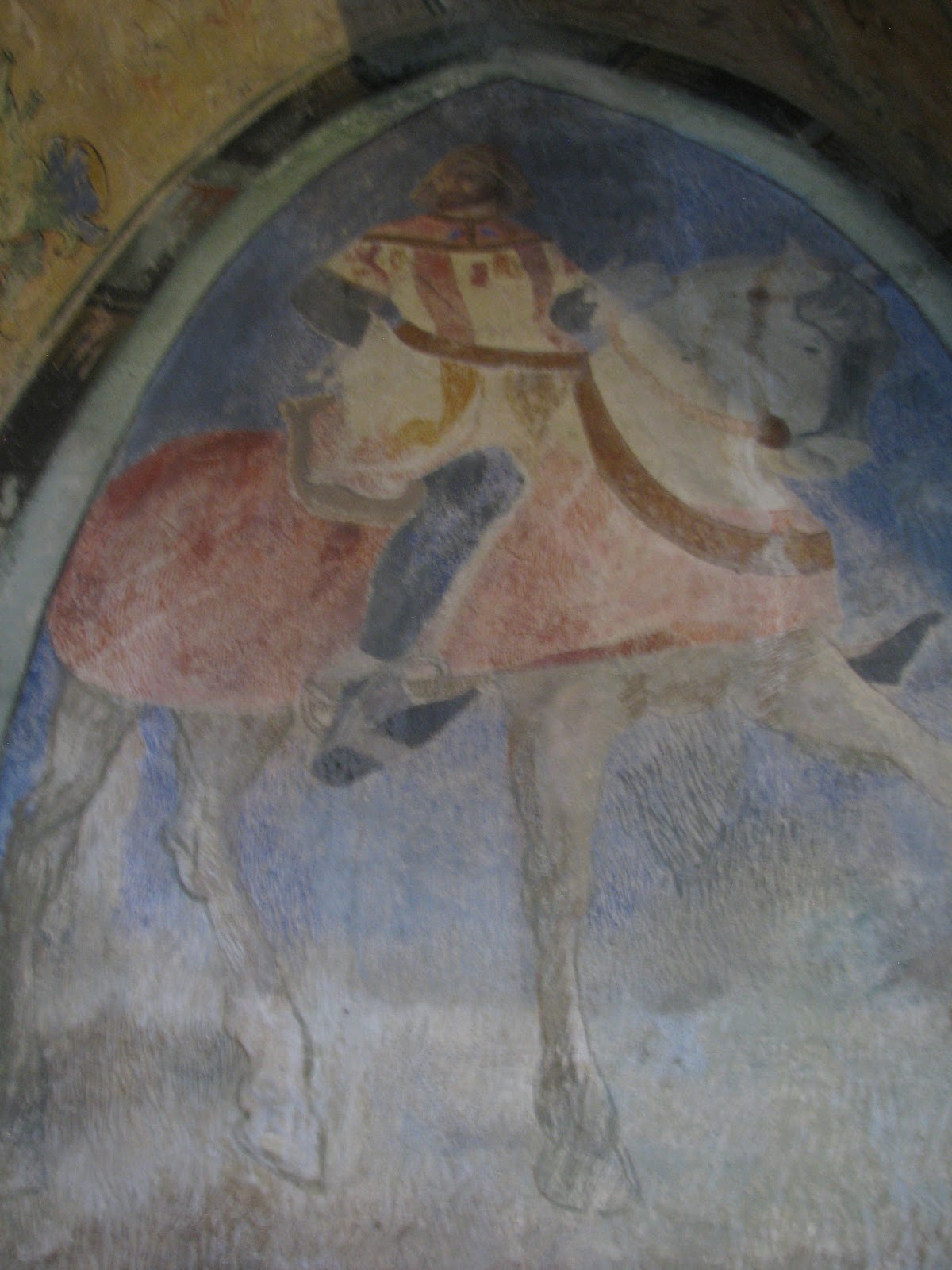
This chapel is still painted in Gothic style with the castle's namesake, St. Mark, and his lion.   

 Even the chapel was designed with defense in mind. The small doorway out kept out heavily armed attackers. The staircase spirals clockwise, favoring the sword-wielding defender (assuming he was right-handed).
 Passing by the castle chaplain’s room, we pass a sand molded metal plate - like those used on the bedroom heating stove - showing the Wedding at Cana.  

Here we enter the Reinbau (Rhine wing) erected in 1706.   Across the hall is the Linen Room with a loom, spinning wheel and tools for working flax. 


 Around 1800, the castle — with diminished military value — housed disabled soldiers. They'd earn a little extra money working raw flax into linen.


Next you see 2000 years of armor in the Rustkammer, showing the evolution of armor since Celtic times.


This Carolinian knight was my favorite (and Aidan - other than the helmet and shoes - I think you and I could make it!)

Since helmets covered the entire head, soldiers identified themselves as friendly by tipping their visor up with their right hand. This evolved into the military salute that is still used around the world today. Armor and the close-range weapons along the back were made obsolete by the invention of the rifle. Armor was replaced with breastplates — pointed (like the castle itself) to deflect enemy fire. This design was used as late as the start of World War I. 

A medieval lady's armor hangs over the door. While popular fiction has men locking their women up before heading off to battle, chastity belts were actually used by women as protection against rape when traveling or during wars. Some things never change.


Finally, in the very center, the Keep (Bergfried) : situated in one of the smallest courtyards in Germany, this served as an observation tower, a dungeon (with a 22-square-foot cell in the bottom), and a place of last refuge. The lowest part was built in 1239, the upper in 168.  It towers 40 m over the base.  The only entrance was 10 m above the ground, accessible only by a specially built ladder or bridge from one of the walls.  When all was nearly lost, the defenders would bundle into the keep and burn the wooden bridge and ladder, hoping to outwait their enemies.
Horse Stable: The stable currently shows off bits of medieval crime and punishment. The ceiling dates to 1239.


As you leave the inner castle thru the Eisern Pforte (Iron Gate), you walk – very carefully – back down the Rider’s Stairway, passing the castle forge and blacksmith’s shop on your left.


Once out, we all took photos of each other and the castle and headed for the souvenir shop.  Lots of cool swords and other weapons for children of all ages.  


We then topped the midday off with one of our favorite new fast food meals: CURRY BRATS and pommes frites.   I like EVERYTHING about this meal: the skin of the brats is crackly, the inside is juicy and bursting with flavor; the rolls are crusty yet moist and chewy inside; the french fries have great flavor and the curry sauce - slightly curried sweetened warm ketsup - is so good you want to sop it all up with the roll.